Summary:
- True household privacy: Split your budget into Mine, Theirs, and Ours. Shared expenses are visible to the whole household; personal spending stays private to each person.
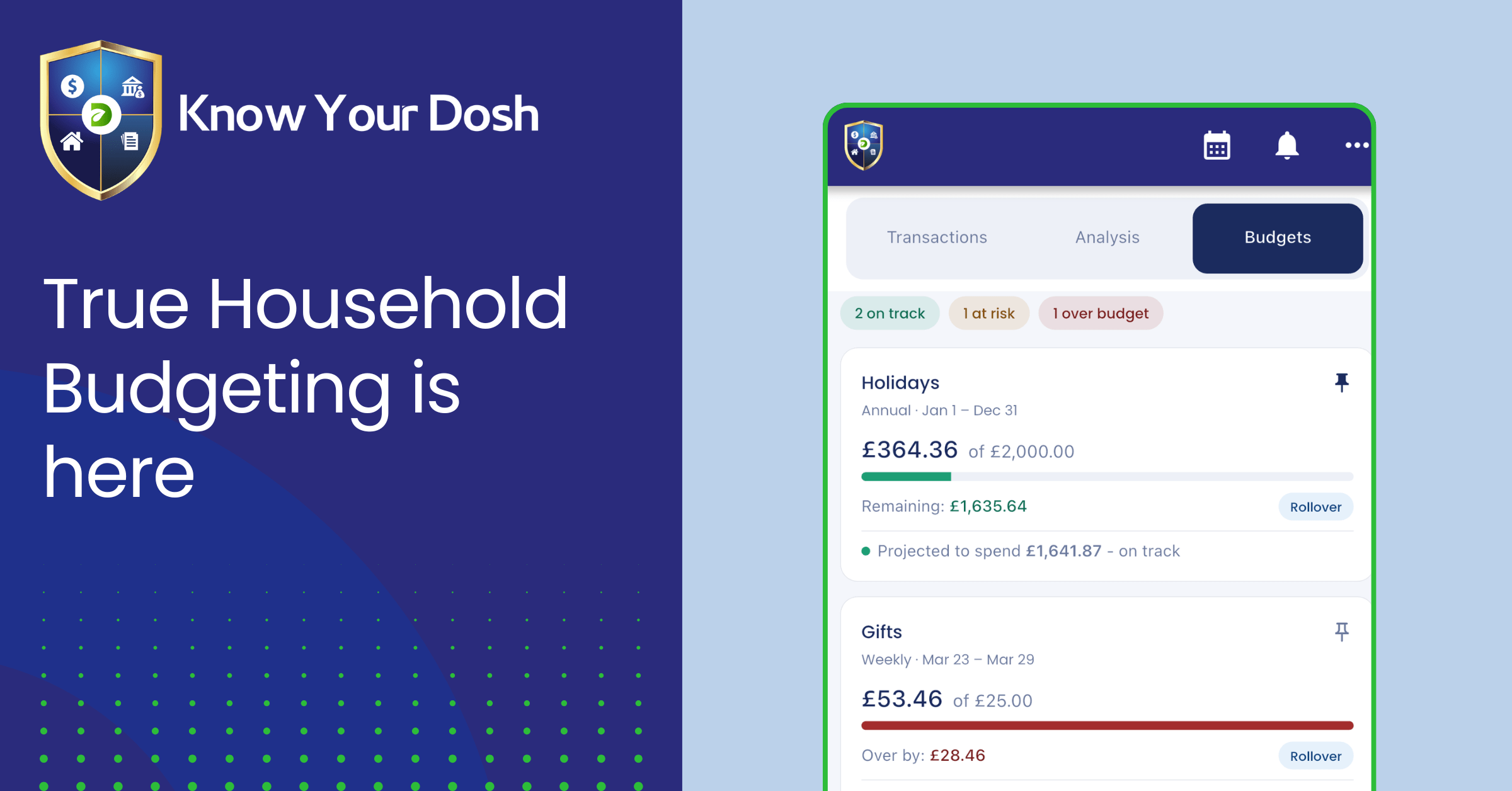
- Three budgeting methods in one app: Choose Flexible budgeting for a structured but low-effort approach, switch on Rollovers so unspent budget carries forward automatically, or go full Zero-Based Budgeting to give every pound/dollar a job.
- Built for real families, everywhere: Multi-currency, international bank connections, and shared access globally.
Household Budgeting
Budgeting apps have a problem they don’t really talk about.
They’re all built for one person. One set of accounts. One financial life. That works fine if it’s just you managing your own money. But the moment there are two of you in the picture, or a whole family, most apps start showing their limits fast.
Your mortgage is shared. Your weekly food shop is shared. Your broadband, your kids’ football club fees, the holiday fund you’re both contributing to: all shared. But your personal spending? That’s yours. The problem is that most budgeting apps can’t tell the difference.
So you end up doing one of three things. Sharing a login (messy, no privacy). Running two separate apps that never talk to each other (pointless for shared expenses). Or one person takes charge of the finances while the other stays largely in the dark (not great for anyone involved).
Know Your Dosh now includes full household budgeting, designed from the ground up for the way real families actually manage money together. Not as an afterthought. Not as a “couples mode” bolted onto a product built for individuals. Built for households, from the start.
The privacy problem that nobody else has solved
Let’s start with the thing that causes the most friction when couples try to budget together – privacy.
Most people are perfectly happy being transparent about shared expenses. The grocery bill, the mortgage payment, the joint holiday savings: all fine. But nobody wants their partner seeing every single transaction. The Friday takeaway you forgot to mention. The birthday present you bought a month early. The coffee you grabbed on the way to work that you know you should have made at home.
Every budgeting app available today handles this badly. Either everything is shared (which puts people off using it properly), or nothing is (which makes household budgeting pointless). The result is that most couples give up, fall back to a spreadsheet, or accept that only one person will actually engage with the finances.
We solve this with what we call Mine, Theirs, and Ours.
Mine is your personal spending. Visible only to you.
Theirs is your partner’s or family member’s personal spending. Visible only to them.
Ours covers shared household categories: groceries, bills, rent or mortgage, joint savings goals. Every household member with access can see exactly how you’re tracking across these.
You get full household visibility on what matters, and complete privacy on what doesn’t. No awkward conversations about individual purchases. No one person managing everything while the other is kept in the dark.
We believe that no other budgeting app in the world does this properly. Not YNAB, not Emma, not Monarch, not Copilot, not Pocketsmith, not Snoop, not Honeydue, not Goodbudget. They all treat budgeting as a single-user activity with a workaround for couples. We built the household in from day one.
The budgeting options
We’ve built three approaches into the app for household budgeting, because different households think about money differently. You’re not locked into one method. Here’s what’s available.
Flexible budgeting
This is where we’d suggest most households start.
The problem with most budgeting apps is that they assume everyone gets paid on the first of the month and spends in tidy monthly chunks. That’s not how most households actually work. You might get paid weekly, every four weeks, or on a date that has nothing to do with when your bills go out. Your grocery budget might make more sense tracked weekly. Your car insurance makes more sense tracked annually.
We’ve built the budgeting period around your life, not the other way round.
For each spending category, you choose the budget period that actually fits:
- Weekly for things you buy regularly and want to keep a close eye on, like groceries or fuel
- Monthly for standard recurring expenses that reset each month
- Quarterly for expenses that come in every few months, utility bills on a quarterly cycle, for example
- Annual for one-off yearly costs like insurance renewals, memberships, or Christmas
- Pay cycle for households where budgeting from payday to payday just makes more sense than following the calendar month
That last one is more significant than it sounds. If you’re paid on the 22nd, budgeting from the 1st means you’re always working across two different pay periods at once. Switch to a pay cycle budget and everything resets when money actually lands in your account. It’s a small change that makes the whole thing feel far less like guesswork.
The result is a budget that reflects how your household genuinely spends, not how a spreadsheet thinks you should.
Rollover budgeting
For any spending category, you can switch on rollovers.
When rollover is on, unspent budget carries forward to the next month. Budget £80 for dining out in March and only spend £50? You’ll have £110 to work with in April.
This is especially useful for variable categories. Car maintenance might sit at zero for two months and then cost £350 in a single trip to the garage. With rollover on, the budget builds naturally in the background, so when that bill lands it doesn’t feel like it’s come out of nowhere.
It’s a small setting that changes how a budget actually feels to live with. Instead of starting from zero every month and hoping nothing unexpected comes up, you’re quietly building breathing room without having to think about it.
Zero-based budgeting
For households who want full control, we support zero-based budgeting (ZBB).
The principle is simple: every pound of income gets assigned to a category before you spend it. Income minus allocations equals zero. Nothing floats around unaccounted for.
It takes more initial setup and a bit more attention each month, but for households working towards a specific financial goal, paying off debt, saving for a house deposit, getting on top of things after a big life change, it’s the most effective method available. When every pound has a job, nothing gets quietly wasted without you noticing.
If you’re new to budgeting together as a household, start with Flexible. Move to zero-based when you want that level of detail and control.
Shared access, on your terms
Whichever method you choose, the household structure runs underneath all of it.
You invite your household members into the app and set their permissions. Want your partner to see all shared categories and budgets in full? Done. Want them to view but not edit? That works too. The level of access is yours to decide, and you can adjust it at any time.
This matters more than it might sound. One of the biggest issues with how couples manage money is that it becomes one person’s job. They track everything, they know where things stand, and the other person is largely guessing. That arrangement puts a lot of pressure on one person and leaves the other feeling out of the loop.
When both partners can check in on the household finances from their own device, in real time, the dynamic changes. Decisions get made together. Neither person is carrying the whole thing alone.
Built for households everywhere
One more thing worth saying about how we’ve built this.
Know Your Dosh works across the globe, with multi-currency support and connections to international banks. Whether you’re managing a household in London, Lagos, or Los Angeles, the budgeting tools work exactly the same way.
Most budgeting apps are essentially US products with a currency layer added on. International bank connections are limited, multi-currency handling is basic, and features that work well for American users often don’t translate cleanly elsewhere. We’ve built for international households from the start, because families don’t always only exist in one country.
Over £150 million in assets are already tracked on the platform, across families in more than 80 countries.
Who is this for?
If any of this sounds familiar, Know Your Dosh was built with you in mind:
- Couples managing shared expenses who still want individual financial privacy
- Families who want household visibility without the complexity of a spreadsheet
- Households where one person currently manages everything and the other wants to be more involved
- Anyone who’s tried YNAB, Emma, Monarch, Copilot, Pocketsmith, Snoop, Honeydue, or Goodbudget and found them too rigid, too individual-focused, or just not built for how your household actually works
How to get started
Setup takes less than 30 minutes. Download the app, connect your accounts, invite your household members, choose your budgeting approach, and you’re live.
Household Budgeting is included on the free tier. Nothing to pay to get started.
Ready to take control of your family finances?
📱 Download the Know Your Dosh mobile app today and start seeing where your money actually goes.
Trusted by families in over 80 countries tracking over £150 million in assets.